
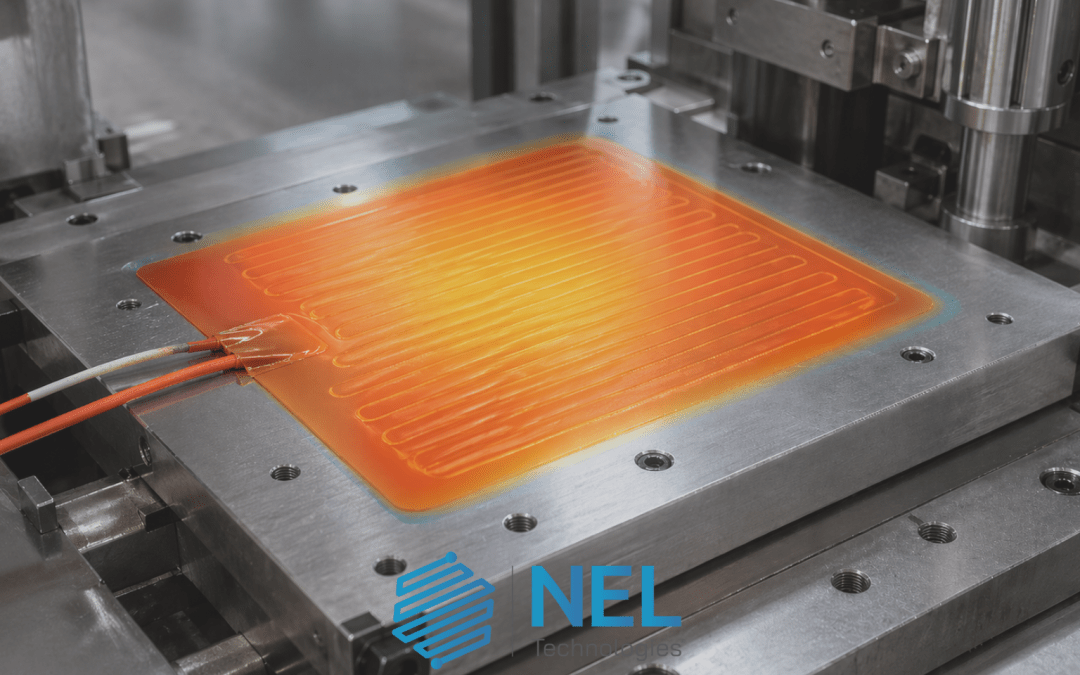
How long do flexible heaters last? In most industrial applications, a well-specified flexible heater should run for years, not months. But there isn’t one fixed lifespan you can quote on a datasheet, because service life is mainly driven by temperature, watt density, mounting, moisture protection, and how the heater is controlled.
If you’ve had a heater fail early, it’s rarely ‘bad luck’. It’s usually a mismatch between the heater build and the real operating conditions. This article breaks down what typically limits flexible heater lifespan, what failure looks like in practice, and the design choices that help you get a longer, more reliable service life.
Flexible heater lifespan depends on heat, mounting, and control
A flexible heater is simple in principle: a heating element laminated into an insulating build, mounted onto a surface so heat transfers where it’s needed. In reality, most lifespan issues come from what happens at the interfaces.
You can learn more about the different types and options on our flexible heaters page.
Three factors matter more than anything else:
- Operating temperature and duty cycle (continuous vs intermittent heating)
- Watt density (how much power you’re pushing through a given area)
- Mounting quality (air gaps, uneven clamping, poor bonding, contaminated surfaces)
If the heater can’t get rid of heat efficiently, internal temperatures rise, materials age faster, and failure comes sooner. If it’s exposed to moisture and the sealing or cable entry isn’t right, you can get corrosion and insulation breakdown or if it flexes repeatedly during thermal cycling, fatigue shows up over time.
What a realistic service life looks like for common flexible heater types
Engineers often want a number. The honest answer is: you can get multi-year service life from most flexible heater types when the heater is designed for the application and installed properly.
What changes is how sensitive each type is to common stressors:
- Silicone rubber heaters tend to be robust in harsher environments, especially where you need better mechanical protection or sealing options. They’re often chosen when moisture, handling, or impact resistance matters.
- Polyimide (Kapton) heaters suit tight spaces and electronics, but thin builds can be less forgiving if there’s repeated flexing, poor contact, or local hotspots.
- Etched foil designs (in either silicone or polyimide builds) help with uniformity because you can control the heat pattern more precisely than a simple wire layout. Uniform heat generally means fewer hotspots, which supports lifespan.
A useful way to think about ‘lifespan’ is to separate two different outcomes:
- The heater still works electrically, but performance has drifted (slower heat-up, uneven zones).
- The heater fails, usually from insulation breakdown, damaged conductors, or problems at the lead exit and terminations.
Most early failures sit in the second bucket and are preventable.
The main causes of flexible heater failure (and how to avoid them)
You’ll see the same patterns across aerospace, medical, satellite, and industrial use cases. The fix is usually not ‘buy a better heater’. It’s ‘spec it differently’.
1) Hotspots from high watt density or poor heat transfer
Watt density is simply power divided by heater area. Higher watt density isn’t automatically wrong, but it gives you less margin for mistakes.
Hotspots happen when:
- the heater is too small for the required output
- there are air pockets under the heater
- clamping pressure is uneven
- the heat sink surface is rough or warped
What to do instead:
- Use the maximum practical heater area, not the minimum that fits
- Focus on full contact: no trapped air, no high spots, no loose edges
- If you need higher power, consider zoned heating or a different construction rather than forcing heat into a small footprint.
2) Adhesive failure (PSA limits, surface prep, and real temperatures)
Adhesive-backed heaters fail early when the adhesive is being asked to do something it isn’t designed for. Often the heater ‘works’, but it lifts, curls, or loses contact and then hotspots follow.
Common causes include:
- operating temperatures above the adhesive’s continuous rating
- poor cleaning or contamination (oil, fingerprints, release agents)
- bonding to painted, powder-coated, or textured surfaces without considering adhesion
What to do instead:
- Treat mounting as a design decision, not an afterthought
- If you’re near temperature limits or need long life, mechanical clamping or a different bonding method is often a better choice than PSA alone
For more detail on material and mounting decisions, see our silicone heater selection guide.
3) Moisture ingress and weak cable entry sealing
If moisture gets into the heater build or the lead exit, you can see corrosion, tracking, and insulation breakdown. This is especially common when IP requirements are assumed rather than specified properly.
If you’re working to an IP rating, it helps to understand what those codes actually mean and how they’re tested. Intertek has a clear overview of ingress protection per IEC 60529.
What to do instead:
- Specify the environment clearly: splash, washdown, condensation, immersion, chemicals
- Treat the cable entry and strain relief as part of the IP requirement, not a minor detail
4) Thermal cycling fatigue, especially in thin builds
Flexible heaters expand and contract with temperature. If the heater is thin and repeatedly flexes during heating and cooling cycles, mechanical fatigue can build up over time, particularly around lead exits, bends, and edges.
What to do instead:
- Consider a thicker build if the heater will see repeated cycling or handling
- Avoid tight bend radii and unsupported lead exits
- Add mechanical protection where movement is unavoidable
5) Control issues: running open-loop or relying on ‘best guess’ power
A heater that’s controlled properly lasts longer. A heater that’s powered without feedback tends to drift into overheating.
What to do instead:
- Specify a temperature sensor (thermistor, RTD, thermocouple) where appropriate
- Use a controller that manages ramp and limits, rather than simple on/off switching
- Add thermal protection where the consequences of overheating are serious
Design choices that extend service life before you place an order
If you want longer service life, it’s usually won in specification, not in troubleshooting.
These are the details worth nailing down early:
- True operating temperature at the heater interface (not just ambient air temperature)
- Duty cycle (continuous, intermittent, heat-up then hold)
- Mounting method (PSA, mechanical clamping, bonded, integrated into an assembly)
- Exposure conditions (moisture, cleaning regime, chemicals, abrasion)
- Heat sink material and surface condition (flatness, roughness, coatings)
- Control approach (sensor type, placement, controller limits)
If you’re designing at system level, the broader context matters too. Our thermal management overview explains how heater selection fits into the wider assembly.
Quick checklist: common failures and the practical fix
| Failure mode | What usually causes it | What to change next time |
|---|---|---|
| Hotspots | Heater too small, air gaps, uneven clamping | Increase area, improve contact, control clamp |
| Adhesive lift | PSA above rating, poor prep, contamination | Change mounting method, clean and prep surfaces |
| Moisture ingress | Underspecified IP, weak cable entry sealing | Specify IP properly, design cable entry and strain relief |
| Cycling fatigue | Thin heater flexing during heat/cool cycles | Thicker build, better strain relief, avoid tight bends |
| Overheating | Poor control, no sensor feedback, localised overheating | Add sensing, limit temperatures, consider thermal protection |
When to replace a flexible heater (signs it’s reaching end of life)
Flexible heaters don’t always fail dramatically. Often they give you warning signs:
- Heat-up time is noticeably slower
- Temperature uniformity gets worse across the heated surface
- The heater begins to lift at edges or around cut-outs
- You see discolouration, cracking, or stiffening of the outer layer
- Intermittent electrical faults, especially near leads and terminations
If you’re seeing these symptoms repeatedly, it’s worth stepping back and checking whether the heater build matches the application. A small change in mounting, thickness, sealing, or control can make a big difference to service life.
Get the heater specifications right before you commit
If you’re trying to extend flexible heater lifespan, the fastest win is usually a better specification, not a last-minute workaround.
You can share requirements with our flexible heater team, including your environment, mounting method, and temperature requirements, and we’ll recommend a construction that fits the job.