
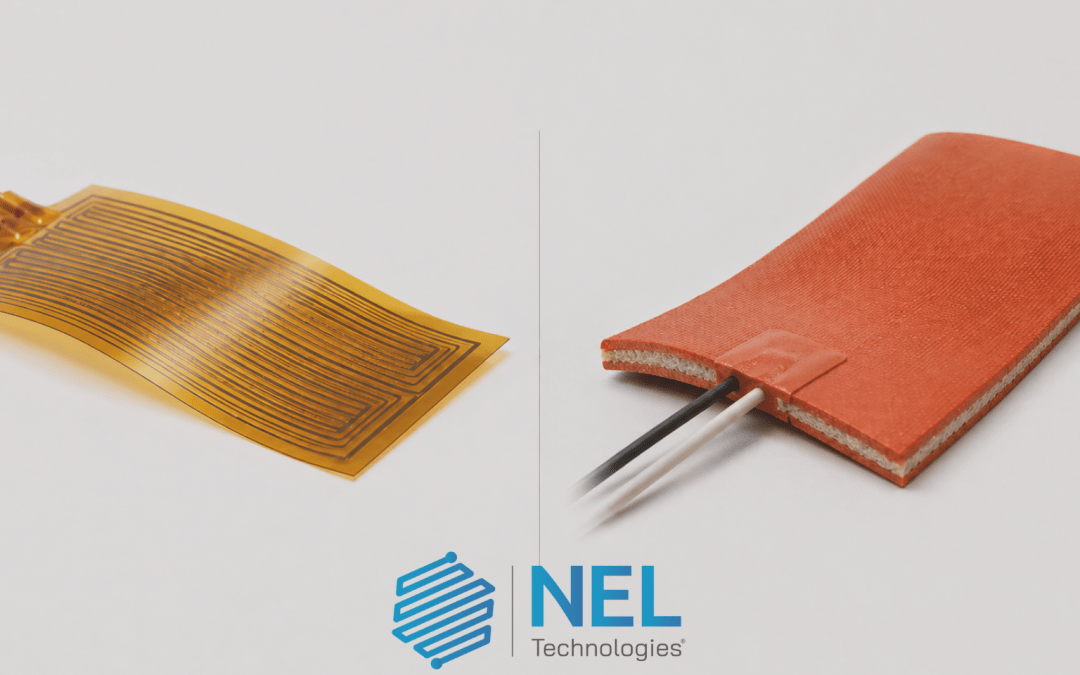
Polyimide and silicone rubber are two of the most widely used dielectric materials in flexible heater design. While both can be used to create efficient, accurate and custom-shaped heaters, they are suited to different operating environments.
Polyimide, often known by the DuPont trade name Kapton, is thin, lightweight and fast to respond. Silicone rubber is thicker, tougher and better suited to harsher environments where moisture, chemicals or mechanical wear may be present.
So, when comparing polyimide vs silicone heaters, the best choice depends on how and where the heater will be used.
How polyimide and silicone heaters compare
Both heater types use etched foil heating elements to provide consistent heat across custom shapes and sizes. The key difference is the insulating material around the heating element. This affects the heater’s thickness, flexibility, durability, thermal response, temperature range and mounting options.
| Characteristic | Polyimide (Kapton) | Silicone rubber |
|---|---|---|
| Typical thickness | 0.1 to 0.2 mm | 1.0 to 1.5 mm |
| Operating temperature range | -195°C to +200°C, adhesive-limited | -60°C to +230°C |
| Thermal response | Fast, due to low thermal mass | Slower, due to higher thermal mass |
| Flexibility and bend radius | Excellent, conforms to tight curves | Good on gentle curves, but stiffer due to thickness |
| Mechanical durability | Lower, more prone to punctures and tears | High, with strong resistance to abrasion, tearing and impact |
| Moisture and chemical resistance | Moderate | Excellent |
| Outgassing | Very low | Higher, so it is not ideal for vacuum environments |
| Maximum watt density | Up to 5 W/cm² | Up to 8 W/cm² |
| Mounting options | Pressure-sensitive adhesive or mechanical mounting | PSA, vulcanised bonding or mechanical mounting |
| Relative cost | Lower | Higher |
When to choose a polyimide heater
A polyimide heater is often the right choice when the application needs a thin profile, low weight and quick thermal response. Because polyimide has low thermal mass, it heats up quickly and can deliver accurate temperature control in compact or sensitive applications.
Polyimide is also well suited to applications where low outgassing is important. This makes it a common choice for space, satellite, vacuum and electronics environments, where contamination needs to be carefully controlled.
Another major advantage is flexibility. A Kapton flexible heater can conform to small-radius curves and fit into spaces where a thicker silicone heater would be too bulky.
However, polyimide heaters are less mechanically robust than silicone rubber heaters. The film can be scratched, punctured or torn if it is exposed to repeated handling, abrasion or impact. For protected installations, this is usually manageable. For physically demanding environments, silicone may be the better option.
When to choose a silicone rubber heater
Silicone rubber heaters are designed for applications where strength, sealing and environmental resistance matter. The thicker silicone construction offers greater protection against abrasion, impact, moisture and many chemicals.
This makes silicone rubber heater applications especially common in industrial settings, outdoor equipment, food processing, defence, machinery and environments where the heater may be exposed to condensation, oils or regular handling.
Silicone rubber can also be vulcanised directly onto a heatsink or substrate, creating a strong, permanent bond with excellent thermal contact. This is useful where the heater needs to remain securely fixed throughout its service life.
The trade-off is size and weight. Silicone heaters are thicker and heavier than polyimide heaters, which can make them unsuitable for compact electronics, lightweight assemblies or applications with strict space limits. They also produce higher outgassing, so they are not usually recommended for vacuum, cleanroom-critical or space environments.
Are silicone heaters better than polyimide heaters?
Silicone heaters are not automatically better than polyimide heaters. They are simply better suited to different conditions.
If the application is exposed to moisture, chemicals, outdoor conditions or mechanical stress, silicone rubber is usually the stronger choice. If the application needs a thin, lightweight heater with fast response and low outgassing, polyimide is usually more suitable.
When comparing a Kapton heater vs silicone heater, the decision should be based on performance requirements rather than material preference.
Choosing the right flexible heater material
If you are unsure which option is right for your application, start by considering the environment, available space and continuous temperature requirements.
What is the operating environment?
Vacuum, cleanroom and space applications usually point towards polyimide. Wet, outdoor, chemically aggressive or mechanically harsh environments usually point towards silicone rubber.
How much space is available?
If the heater needs to be as thin and light as possible, polyimide is usually the better choice. If there is more available space and durability is more important, silicone rubber may be more suitable.
What temperature does the heater need to operate at?
Both materials can work well up to around 200°C in standard etched foil constructions. The polyimide heater temperature range can be affected by adhesive limits, while silicone rubber can often withstand slightly higher continuous operating temperatures.
Speak to NEL Technologies about flexible heater material selection
At NEL Technologies, we manufacture both polyimide and silicone flexible heaters using etched foil technology. With over 35 years of experience across aerospace, medical, space, defence and Formula 1 applications, we can recommend the most suitable material for your operating conditions.
Because both heater types are manufactured in-house, our guidance is based on your application, not a one-size-fits-all product recommendation.
If you are comparing heater materials for a project, describe your application requirements to our engineering team and we will help you choose the right build.