
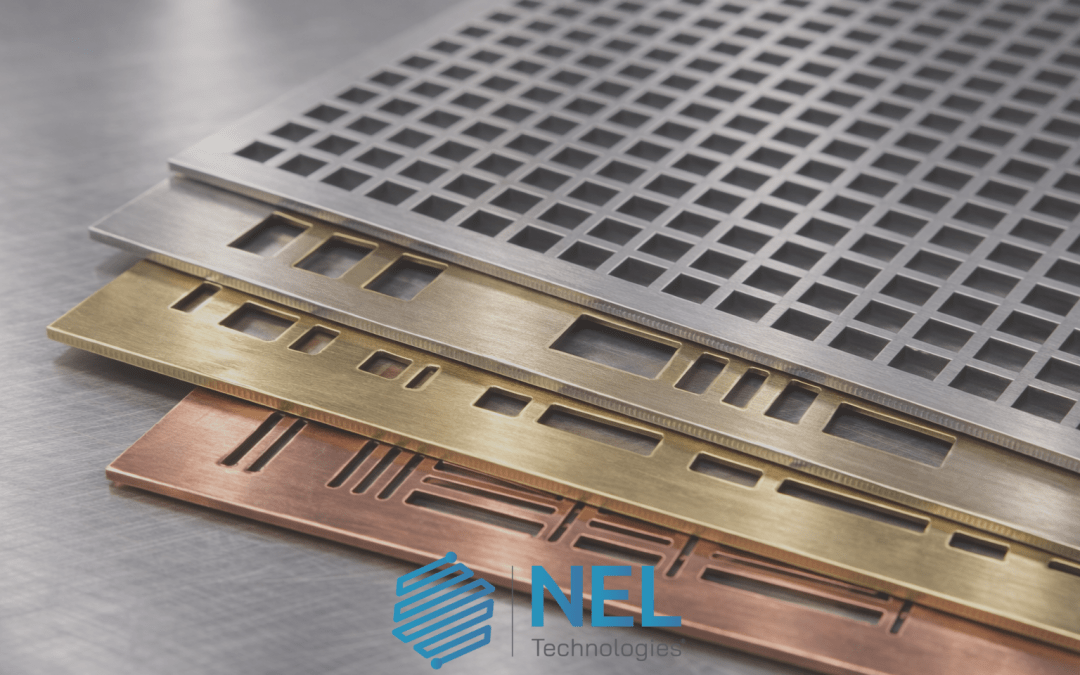
Photo chemical machining works with most engineering metals in sheet or foil form. Stainless steels, brass, copper, nickel alloys and specialist spring materials all etch predictably, but material choice affects feature sizes, edge definition, tolerances and post-etch forming behaviour.
Choosing the right material is the first step toward parts that meet specification without late-stage iteration. Below is what’s achievable by material family, and where thickness and mesh design introduce additional constraints.
Which Materials Can Be Photo Etched?
Chemical etching removes metal through a controlled reaction, so any metal that reacts predictably with the etchant is a candidate. In practice, that covers most precision engineering metals:
Ferrous: stainless steels (304, 316, 301, ferritic and martensitic grades), mild steel, spring steel, electrical steel.
Non-ferrous: brass, phosphor bronze, beryllium copper, copper (standard and oxygen-free), aluminium.
Specialist: Inconel, Monel, Mu-metal, Invar, Kovar, molybdenum, titanium.
NEL has etched materials from 25µm foil to 2mm plate across medical diagnostics, Formula 1 and aerospace over 35+ years. Material compatibility is the starting point, but hardness, temper and grain structure all influence what’s achievable. For the full workflow, see our photo chemical machining process.
Stainless Steel
The material NEL etches most. Stable, widely available, and supports fine features with good dimensional control.
- 304 is the most widely specified grade, covering medical devices, enclosures, food equipment and general precision work.
- 316 adds molybdenum for chloride and chemical resistance, common in pharmaceutical and surgical applications.
- 301 in spring temper handles springs, clips and flexures, though it work-hardens more, affecting post-etch forming.
Two things tend to matter more than grade when pushing tolerances:
Temper. Annealed stainless etches cleanly and forms easily. Half-hard and full-hard retain strength but resist forming and increase springback. If the part needs bending after etching, temper choice needs to be deliberate.
Grain size. Finer grain improves edge definition on small apertures. At sub-millimetre features, treat material specification as part of the tolerance strategy.
Brass and Copper
Both are common when electrical or thermal conductivity matters, or when you need formability after etching.
Brass gives strong edge definition and forms more easily than stainless. The trade-off: it’s softer, so fine parts are more susceptible to handling damage. Common for contacts, springs and decorative components.
Copper (including oxygen-free grades) is specified for heat spreaders, shielding, busbars and thermal management. It etches cleanly but is softer again, making handling critical on thin stock.
Both materials oxidise faster than stainless. If solderability or long-term surface behaviour matters, build plating or protective finishing into the manufacturing sequence from the start.
Specialist Alloys
Typically chosen for one critical property. The key is knowing how that affects etchability.
Phosphor bronze pairs conductivity with fatigue resistance for contacts that flex repeatedly.
Beryllium copper offers very high strength with good conductivity for demanding springs and contacts. Some grades are heat-treated after etching.
Nickel alloys come into play for temperature, corrosion or chemical resistance. Inconel for heat, Monel for marine environments, Mu-metal for magnetic shielding, Invar and Kovar for low thermal expansion in precision instruments.
These materials etch more slowly and need specific chemistries, but produce clean results when the design works within thickness and feature size realities.
Thickness and Tolerances
One rule worth remembering: feature widths shouldn’t go significantly smaller than material thickness if you want clean definition and stability.
Thin foils (25 to 100µm) allow very fine features. Common in medical diagnostics and micro-scale work.
Mid-range (0.1 to 0.5mm) is the most common band for precision shims, gaskets, EMI shielding, encoder discs and perforations.
Thicker plate (0.5 to 2mm) gives rigidity for brackets and mounting plates, but minimum feature sizes increase.
Thinner material allows finer work. Thicker material needs more conservative feature sizing to keep edges clean.
Photo Etched Mesh
Etched mesh is chosen when punched or drilled patterns become expensive, inconsistent or impractical. The process suits fine apertures, complex patterns and controlled open-area percentages.
Common applications: filtration and flow control, atomisation plates, ventilation panels, speaker grilles.
Two constraints matter early.
Minimum aperture size: round holes smaller than material thickness can be difficult to clear reliably.
Web width: solid material between apertures should stay at or above thickness for structural integrity.
If mesh function is critical to your application, supplier capability and inspection approach matter. See our guidance on choosing the right etching supplier.
Getting Parts Right
Material compatibility is the start. Getting photo etched parts right means understanding how material properties influence features, tolerances, forming and finishing.
NEL’s photo chemical machining capabilities cover ferrous, non-ferrous and specialist alloys with in-house verification and prototype development.If you’re unsure whether your material and feature combination is manufacturable, share your CAD file, material specification and critical tolerances with our team for feasibility confirmation.