
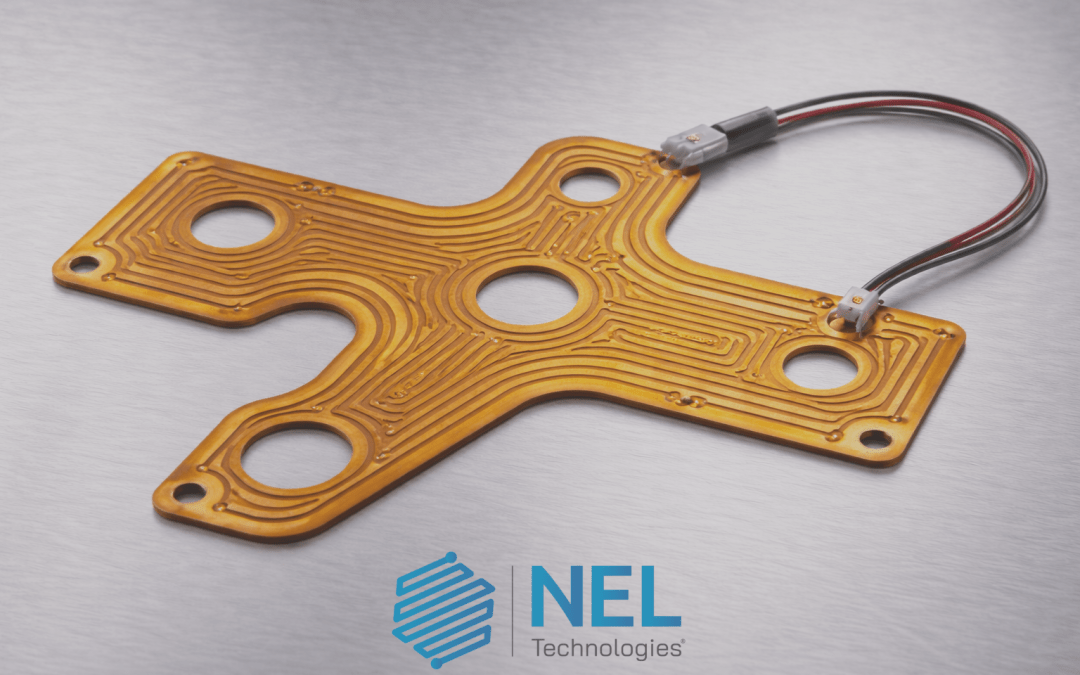
Selecting a flexible heater for your application comes down to three practical questions: what temperature you need to hold, what surface you’re heating, and what the environment will do to the heater over time. Get those right, and the heater will behave predictably. Miss one, and you can end up with hotspots, lifted edges, moisture-related faults, or a heater that simply does not last as long as it should.
This guide helps you choose the right heater type, mounting method and control approach without over-specifying the build or leaving gaps that show up later in testing.
If you want a quick overview of what NEL manufactures, start with our bespoke flexible heater options.
Start with the application, not the heater type
Most heater selection problems happen when the spec starts with “we need a Kapton heater” or “we need a silicone mat”. Those are valid options, but they are not the starting point.
A better starting point is the job the heater has to do:
- Target temperature and stability: are you warming, maintaining, or cycling?
- Heat-up time: do you need a fast ramp or steady, gentle heating?
- Heated surface: flat plate, gentle curve, tight radius, complex geometry
- Heat sink behaviour: aluminium, stainless, composites, insulated assemblies
- Environment: moisture, washdown, chemicals, abrasion, vacuum, clean environments
- Lifetime expectations: continuous operation vs occasional use, planned maintenance vs “fit and forget”
Once you have these, choosing the heater construction becomes much simpler.
Choose the heater construction that fits the job
Flexible heaters tend to fall into a few common build families. The right one depends on packaging, durability needs, and how sensitive your application is to temperature uniformity.
Quick comparison of common flexible heater types
| Heater type | Best for | Watch-outs |
| Silicone rubber heater | Harsh environments, handling, moisture protection, durable builds | Can be thicker, mounting needs care to avoid air gaps |
| Polyimide (Kapton) heater | Tight packaging, electronics, lightweight assemblies | Thin builds can be less forgiving with poor contact or repeated flexing |
| Etched foil heater (silicone or polyimide) | Better heat uniformity, repeatable patterns | Needs good spec on watt density and mounting to avoid hotspots |
| Wire-wound heater | Simple shapes, lower complexity builds | More prone to local hot lines, less control over uniformity |
If the application cares about uniform heating, etched foil patterns are often the sensible route because you can distribute heat where it’s needed rather than relying on a single wire path.
Match the heater to the environment you actually have
Environment is where “a heater that worked in the lab” can fail in the field.
Temperature and thermal cycling
Ask two separate questions:
- What is the maximum operating temperature at the heater interface?
- How often will the system cycle between temperatures?
Thermal cycling introduces mechanical fatigue at edges, around cut-outs, and at lead exits. If the heater will cycle frequently, you may need a build that tolerates movement better, plus proper strain relief and cable routing.
Moisture, condensation, and cleaning
Moisture does not need to be dramatic to cause issues. Condensation inside an enclosure can be enough over time if sealing and cable entry are not designed properly.
If you need an IP rating, be clear about the type of exposure:
- splash and occasional wipe-down
- washdown and jets
- condensation and humidity
- outdoor exposure
- immersion (rare, but it happens)
Chemicals and surface contamination
If the heater sits in an environment where it may contact oils, solvents, cleaning agents or process chemicals, the outer layer and the bonding approach matter. It’s worth calling this out early, even if exposure is only occasional.
Mounting is where most heater problems start
A flexible heater is only as good as its contact with the surface it’s heating. Poor contact creates air gaps. Air gaps create hotspots. Hotspots shorten life.
There are three common mounting routes:
1) Adhesive-backed mounting
This is quick and tidy, but it is not always the most durable option.
It works well when:
- the surface is clean, smooth, and stable
- operating temperatures stay comfortably within adhesive limits
- you do not expect frequent removal or rework
It becomes risky when:
- temperature is close to the adhesive’s continuous rating
- surfaces are coated, textured, or hard to prep
- the heater will see frequent cycling that peels edges over time
If you do use adhesive, surface prep is part of the spec, not an install note. Define cleaning method, acceptable coatings, and any primer requirements.
2) Mechanical clamping or fixing
Clamping can be the most reliable option for long-life builds because it avoids adhesive ageing. But it needs proper pressure distribution.
Good practice includes:
- consistent clamping force across the heater area
- avoiding point loads at corners
- using a flat, stable heat sink surface
- designing cable exits so they do not become stress points
3) Integrated mounting (bonded into an assembly)
In some assemblies, the best option is to build the heater into the product so it cannot lift, creep, or be installed inconsistently. This is common when repeatability matters and field installation variation is a risk.
If you’re unsure which route is best, it’s usually worth discussing mounting early rather than “choosing later”. Heater life and uniformity depend on it.
Control and sensing: the difference between stable heat and burnt-out heaters
A lot of heater selection discussions focus on the heater itself, but control is what makes the system predictable.
Questions to answer early:
- Do you need a temperature sensor on the heater, on the surface, or in the environment?
- Is the goal to control surface temperature, air temperature, or a component temperature?
- What happens if the sensor fails or loses contact?
If the consequences of overheating are serious, include protection:
- temperature limiting in the controller
- thermal cut-outs where appropriate
- correct fusing and wiring spec
You do not need an overcomplicated control system for every heater, but you do need one that matches the risks.
What to include in an RFQ so the heater is specified properly
A good RFQ shortens lead time and reduces the number of “we need to clarify” cycles.
Include:
- target temperature and allowable tolerance band
- ambient and interface temperatures
- duty cycle (continuous, intermittent, heat-up then hold)
- heater dimensions, shape, and any cut-outs
- substrate material and thickness (what you are heating)
- mounting method (adhesive, clamp, integrated)
- environment (moisture, cleaning, chemicals, abrasion)
- voltage and available power
- sensor requirements (type and placement)
- any IP requirement and what exposure it must handle
- expected service life and maintenance assumptions
Get a selection recommendation that matches your real conditions
If you’re selecting a flexible heater and want to avoid the common failure modes, it helps to sanity-check watt density, mounting and environmental protection before anything is manufactured.
Share your application details with NEL and we’ll recommend a heater construction that fits the job.