
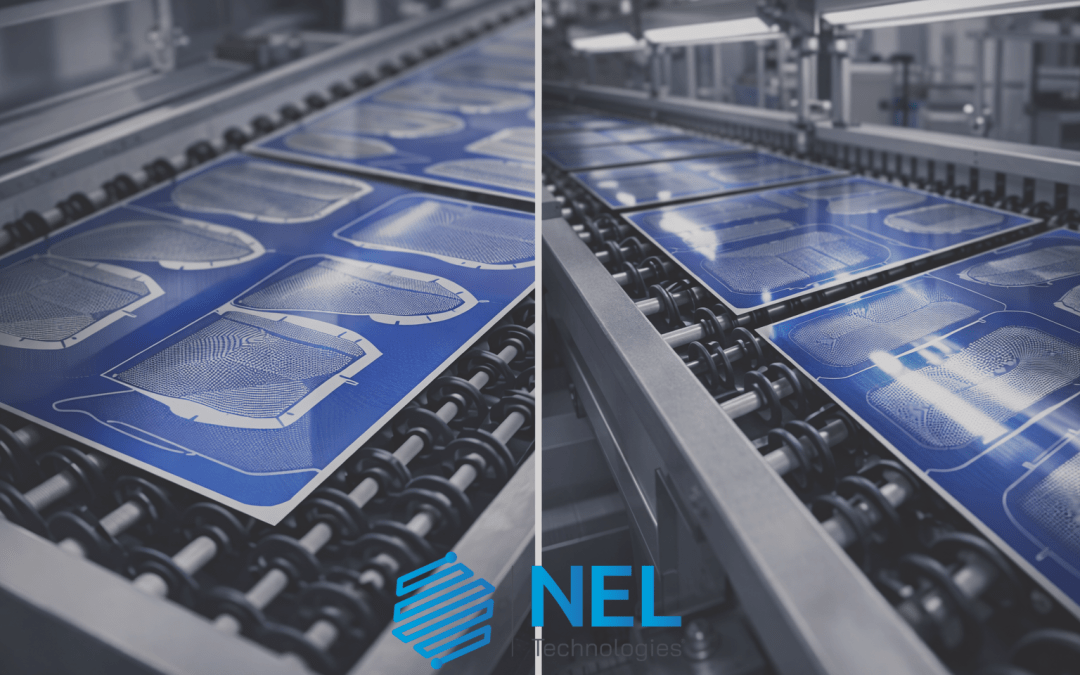
Chemical etching is a precision sheet-metal process where a light-sensitive photoresist ‘mask’ protects the areas you want to keep, and a controlled chemical etchant removes the exposed metal to create the final geometry. It’s often the best fit for fine-detail 2D parts in thin sheet where you want consistent features and clean edges without the heat effects of laser cutting or the stresses of punching and stamping.
If you’re exploring it for a real component, see our Photo Chemical Machining (PCM) capability.
What is chemical etching?
Chemical etching sits within a family of terms that are often used interchangeably. You’ll commonly hear chemical etching, photochemical machining (PCM), photochemical etching, chemical etching, and chemical milling used to describe the same core idea: a patterned photoresist protects the metal you want to keep, and an etchant removes the exposed areas.
You may also see phrases like ‘acid etching’ or ‘etching aluminium’. In practice, those usually refer to the same process, just described in a different way or tied to a specific material. The key point is the outcome: a controlled, repeatable method for producing high-detail sheet-metal components where precision comes from the pattern and process control, not cutting force.
How chemical etching works step by step
Most PCM workflows follow a consistent sequence. The detail varies by supplier, but the principles are the same.
Prepare the artwork and photo-tool
Your CAD or drawing is converted into a mask (often called a photo-tool) that defines what gets etched and what stays. This is where good manufacturing input can save time, especially if you have very fine features or tight spacing.
Clean the sheet and apply photoresist
The metal sheet is cleaned, then coated or laminated with a UV-sensitive photoresist on one or both sides. The quality of this surface preparation influences consistency later.
UV exposure and developing
The photoresist is exposed to UV light through the patterned mask, then developed so the correct areas are left protected and the etched areas are exposed.
Etching
The sheet is then etched, often using spray etching, with a chemical etchant such as ferric chloride in many applications. The etchant dissolves the exposed metal while the resist protects the rest.
Strip, clean, finish
Once etched, the resist is removed and parts can be cleaned and finished. Depending on the specification, this can include inspection, secondary operations, or integration into assemblies.
What is Chemical etching used for?
Chemical etching is widely used for precision components where complex geometry and repeatability matter. Precision Micro lists common PCM applications such as shims, flat springs, lead frames, electrical connectors, EMI shielding, filters/flow plates, and medical devices.
In practical engineering terms, chemical etching is a strong fit when:
- The part is fundamentally 2D (sheet-based)
- You need fine features or dense patterns
- Edge quality and material integrity matter
- You want to avoid expensive hard tooling early on
It’s also used in thermal and electrical contexts, for example where etched metal patterns support controlled performance. (If your project includes thermal control, our heater capability may be relevant.
Key advantages and limitations
Chemical etching tends to be chosen for quality and control, but it has boundaries. Being clear about both helps avoid redesign later.
Advantages you can reasonably expect
Clean edges with no mechanical force
Because PCM does not rely on shearing or cutting force, it avoids the mechanical stresses associated with some traditional methods. This is often presented as a route to burr-free edges and stress-free parts.
Fine detail and complex geometries
The photo-tool and resist define the geometry, which allows intricate patterns that may be difficult or impractical to produce by stamping or laser cutting, especially in thin materials.
Cost-effective for complex parts without hard tooling
PCM can be efficient when complexity is high or when you need iterations, because you’re not committing to hard tooling in the same way you would with stamping.
Limitations to plan around
Material thickness range
Chemical etching is best suited to thinner sheet. Several industry guides cite typical working ranges up to around 2.5 mm, depending on material and design.
Part size is constrained by sheet and equipment
Maximum sheet size varies by supplier and machinery, which can cap the maximum part footprint. Precision Micro notes that PCM part size is limited by sheet size and the width of etching machinery.
Not ideal for thick, 3D, or very simple high-scale parts
PCM is a sheet process, so it’s not a route to deep 3D machining. And for very simple geometries at very high volumes, traditional sheet methods can be more cost-effective.
Chemical etching is usually strongest for fine detail in thin sheet when you want clean edges and easy iteration. If you’re deciding between chemical etching and laser cutting, we break it down in a separate guide.
What affects accuracy and consistency?
Accuracy in chemical etching depends on the relationship between feature size and material thickness, and on process control (resist, exposure, etchant chemistry, and handling). Precision Micro’s engineering guidance ties achievable tolerances to thickness, noting different expectations across thin vs thicker ranges.
In practice, you’ll get better outcomes when you:
- Identify your truly critical dimensions (not every edge needs the same tolerance)
- Share the intended function (what the feature is doing in the assembly)
- Align on inspection approach early (what will be measured and how)
If you’re planning a component with multiple constraints (performance, cleanliness, integration), it’s often worth a short feasibility review early.
What you need to start a chemical etching project
You don’t need a perfect documentation pack, but you do need enough clarity for a supplier to advise properly.
- CAD or drawing file (with revision control)
- Material and thickness (or performance requirement if undecided)
- Quantity and expected demand (prototype only, pilot, production)
- Critical dimensions and tolerances
- Any finishing or secondary requirements (plating, passivation, forming)
- Handling/cleanliness requirements (packaging, contamination constraints)
- Downstream operations (assembly, inspection reporting)
Next steps: check fit, then scope your specification
If you’re considering it for a real component, the fastest next step is a quick feasibility check. Share your drawing (or even an early concept), plus material, thickness, quantity, and the few dimensions that matter most. You can explore our Photo Chemical Machining capability here.